
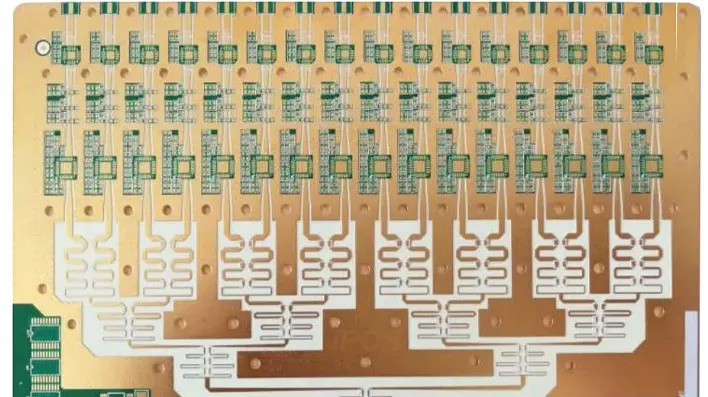
RF PCB for Aerospace Applications
Aerospace systems represent some of the most demanding RF PCB applications in the electronics industry. These applications require exceptional reliability under extreme environmental conditions, including temperature variations from -65°C to +200°C, high-altitude pressure changes, and intense radiation exposure.
Critical Requirements and Technical Challenges
Aerospace RF PCBs must demonstrate superior performance characteristics including ultra-low insertion loss, typically below 0.1 dB per inch at X-band frequencies, and exceptional temperature stability with thermal coefficients of dielectric constant below 50 ppm/°C. The material selection becomes critical, with PTFE-based laminates such as Rogers RO3003 or RO4350B commonly specified for their stable dielectric properties and low outgassing characteristics meeting NASA standards.
Signal integrity preservation across wide frequency ranges presents significant design challenges. Satellite communication systems operating from L-band through Ka-band require careful impedance control and RF PCB design optimization to minimize phase distortion and maintain consistent performance across the operational bandwidth.
Typical Applications
Key aerospace applications include phased array radar systems, satellite transponders, electronic warfare countermeasures, and navigation systems. Each requires specific performance optimization, from the ultra-wideband requirements of electronic support measures to the precise phase matching needed in synthetic aperture radar applications.
RF PCB in Military Electronics Applications
Military electronics demand the highest levels of reliability and performance under the most challenging operational conditions. RF PCB in military electronics must withstand extreme shock, vibration, and electromagnetic interference while maintaining precise signal characteristics.
Ruggedization and Performance Standards
Military RF PCBs typically require qualification to MIL-PRF-31032 standards, encompassing thermal cycling from -55°C to +125°C, vibration resistance up to 2000 Hz, and humidity exposure testing. The RF PCB characteristics must remain stable throughout these environmental extremes, requiring careful material selection and specialized manufacturing processes.
Electromagnetic compatibility becomes paramount in military applications, with RF PCBs designed to minimize both emissions and susceptibility to jamming signals. This often necessitates advanced shielding techniques, controlled impedance structures, and careful ground plane design to maintain signal integrity in hostile electromagnetic environments.
Security and Manufacturing Considerations
Military applications often require domestically sourced materials and manufacturing to meet security requirements. This includes ITAR-compliant production processes and supply chain verification, particularly for classified defense programs involving advanced radar and communication systems.
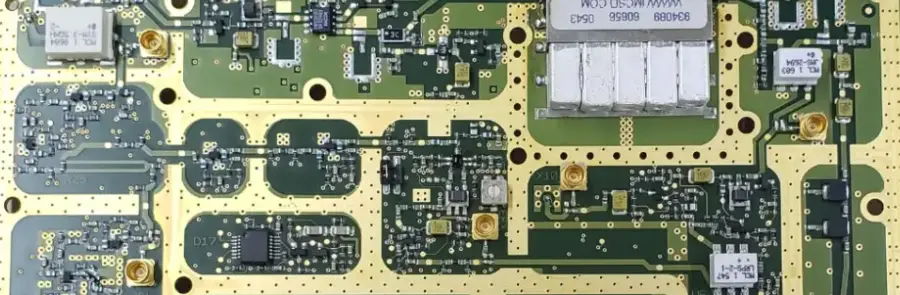
RF PCB
RF PCB for Medical Devices Applications
Medical device applications represent a rapidly growing segment of RF PCB for medical devices, driven by advances in wireless patient monitoring, implantable devices, and diagnostic imaging systems. These applications require unique considerations for biocompatibility, power efficiency, and regulatory compliance.
Biocompatibility and Safety Requirements
Medical RF PCBs must meet strict biocompatibility standards, particularly for implantable devices. Materials must demonstrate compatibility with ISO 10993 testing protocols, ensuring no adverse biological reactions. This often limits material choices to specific laminates with proven biocompatible properties and requires specialized surface finishes that maintain long-term stability in biological environments.
Power consumption optimization becomes critical for battery-powered medical devices, requiring RF PCB materials with ultra-low loss tangent properties to maximize battery life. Advanced medical implants often operate for years without battery replacement, demanding exceptional efficiency in RF circuit design.
Regulatory Compliance Challenges
Medical RF PCBs must comply with FDA regulations and international standards such as IEC 60601 for medical electrical equipment. This includes specific requirements for electromagnetic compatibility, safety isolation, and performance verification across the operational frequency ranges used in medical applications.
5G RF PCB Design: Advanced Solutions for Next-Generation Networks
5G RF PCB design represents one of the most technically challenging applications in modern electronics, requiring unprecedented performance levels across millimeter-wave frequency ranges while supporting massive MIMO antenna arrays and advanced beamforming capabilities.
Millimeter-Wave Frequency Challenges
Operating frequencies extending from sub-6 GHz through 39 GHz and beyond to 71-86 GHz bands present significant technical challenges for PCB design and manufacturing. At these frequencies, traditional design approaches become inadequate due to increased conductor losses, dielectric losses, and the wavelength approaching PCB feature dimensions.
Conductor roughness becomes a critical factor at millimeter-wave frequencies, with RMS surface roughness directly impacting insertion loss performance. Smooth copper foils with RMS roughness below 0.5 micrometers become necessary to minimize conductor losses, while specialized plating processes may be required to achieve optimal surface finish characteristics.
Advanced Material Requirements
5G applications demand RF and microwave PCBs utilizing advanced low-loss dielectric materials with dissipation factors below 0.002 at millimeter-wave frequencies. Materials such as Rogers RO3003G2 or Isola I-Tera MT40 provide the necessary electrical performance while maintaining manufacturability for complex multilayer constructions.
Thermal management becomes increasingly critical as power densities increase in 5G infrastructure equipment. Advanced thermal interface materials and embedded cooling solutions may be integrated directly into the PCB stackup to manage heat dissipation from high-power amplifiers and digital processing circuits.
Signal Integrity and Manufacturing Precision
The shorter wavelengths at 5G frequencies require unprecedented manufacturing precision, with dimensional tolerances often specified at ±0.025mm or tighter. Via aspect ratios must be carefully controlled to prevent resonances, while differential pair routing requires precise impedance control typically within ±5% to maintain signal integrity.
Advanced manufacturing techniques including laser drilling for microvias, sequential lamination for complex stackups, and precision impedance testing become standard requirements for 5G RF PCB production. Quality control processes must include high-frequency measurements and time-domain reflectometry to verify electrical performance across the operational bandwidth.
Massive MIMO and Beamforming Implementation
5G base stations employing massive MIMO technology require RF PCBs supporting 64, 128, or more antenna elements with precise phase and amplitude matching. This necessitates careful attention to trace length matching, typically within ±0.1mm, and consistent impedance control across all signal paths to enable effective beamforming performance.
RF PCB in Wearables Applications
The growing RF PCB in wearables market demands innovative solutions for compact, power-efficient designs that maintain reliable wireless connectivity while conforming to ergonomic constraints and aesthetic requirements.
Miniaturization and Integration Challenges
Wearable devices require extreme miniaturization while maintaining adequate RF performance for Bluetooth, WiFi, and cellular connectivity. This often necessitates innovative packaging approaches including rigid-flex constructions that conform to curved device housings while minimizing interconnect losses.
Antenna integration within the limited space constraints of wearable devices requires careful coordination between mechanical design and RF performance optimization. Printed antennas, chip antennas, and flexible antenna solutions must be carefully evaluated for each specific application.
Power Efficiency Optimization
Battery life optimization drives many design decisions in wearable RF PCBs, requiring ultra-low power consumption during standby modes while maintaining adequate performance during active communication periods. This often involves sophisticated power management integration and careful selection of low-power RF components optimized for duty-cycled operation.
Haoyue Electronics: Advanced RF PCB Manufacturing Capabilities
As the complexity of RF PCB applications continues to increase across these diverse industry sectors, selecting the right manufacturing partner becomes crucial for project success. Haoyue Electronics provides comprehensive RF PCB manufacturing and assembly services specifically designed to meet the demanding requirements of high-frequency applications. Our expertise in RF microwave PCB manufacturing challenges enables us to deliver reliable solutions for the most demanding applications.
Specialized Manufacturing Capabilities
- Advanced multilayer construction up to 20 layers with controlled impedance tolerance of ±5%
- Precision drilling capabilities supporting via aspect ratios up to 12:1 for high-frequency applications
- Low-loss material processing including Rogers, Isola, and Taconic substrates
- High-frequency testing and validation up to 67 GHz frequency range
- ITAR-compliant manufacturing processes for defense and aerospace applications
- Medical device quality systems supporting FDA-regulated applications
- Flexible and rigid-flex capabilities for wearable and compact device applications
Our experienced engineering team works closely with customers to optimize designs for manufacturability while maintaining the critical electrical performance required for each specific application. Whether you require prototype development or high-volume production, we provide the technical expertise and manufacturing capabilities to support your RF PCB manufacturer requirements.
For specialized RF PCB applications requiring proven manufacturing expertise and comprehensive quality systems, contact Haoyue Electronics to discuss your project requirements and discover how our capabilities can support your next-generation product development.
Frequently Asked Questions
1. What are the key differences between RF PCBs for different applications?
The primary differences lie in environmental requirements, frequency ranges, and performance specifications. Aerospace RF PCBs require extreme temperature stability and radiation resistance, military applications demand ruggedization and EMI protection, medical devices need biocompatibility and ultra-low power consumption, 5G systems require millimeter-wave performance and high integration density, while wearables prioritize miniaturization and power efficiency.
2. How do material choices impact application-specific RF PCB performance?
Material selection directly affects electrical performance, environmental stability, and manufacturing feasibility. High-frequency applications benefit from low-loss dielectric materials like PTFE composites, while cost-sensitive applications may utilize enhanced FR-4 materials. Temperature-stable applications require materials with low thermal coefficients, and medical applications may require biocompatible material certifications.
3. What are the most critical design considerations for 5G RF PCB applications?
5G RF PCB design requires careful attention to conductor roughness minimization, precise impedance control, thermal management integration, and manufacturing tolerance optimization. Millimeter-wave frequencies demand advanced materials with ultra-low loss tangent properties and specialized via structures to minimize parasitic effects at high frequencies.
4. How do testing and validation requirements differ across RF PCB applications?
Testing requirements vary significantly by application. Aerospace applications require extensive environmental qualification testing, military applications demand EMI/EMC validation and security compliance, medical devices need biocompatibility and regulatory testing, while 5G applications require high-frequency parameter validation and thermal performance verification.
5. What manufacturing capabilities are essential for application-specific RF PCB solutions?
Essential capabilities include advanced material processing for specialized substrates, precision manufacturing with tight dimensional tolerances, high-frequency testing and validation equipment, environmental qualification testing capabilities, and quality systems appropriate for the target application sector including aerospace AS9100, medical ISO 13485, or automotive IATF 16949 certifications.