
Essential Requirements for RF PCB Manufacturing
Modern RF PCB manufacturing demands specialized equipment, controlled environments, and extensive material expertise. Unlike standard PCB fabrication, RF circuits operate at frequencies where traditional manufacturing approaches prove inadequate. The RF PCB manufacturer must demonstrate proficiency in handling substrates with specific dielectric constants, managing impedance variations within tight tolerances, and executing complex layer stackups.
Key manufacturing requirements include:
- Advanced impedance control systems capable of ±5% tolerance or better
- Specialized drilling equipment for micro-vias and high-aspect-ratio holes
- Controlled dielectric thickness management across multiple substrate types
- Surface finish capabilities including HASL, ENIG, and immersion silver
- Environmental controls maintaining temperature and humidity stability during fabrication
The high frequency PCB manufacturer must also possess comprehensive testing capabilities, including time-domain reflectometry (TDR) and vector network analyzer (VNA) measurements to verify electrical performance before delivery.
Technical Capabilities Every RF PCB Manufacturer Must Have
Advanced Material Handling and Processing
Professional RF PCB fabrication begins with material selection and processing expertise. Rogers materials, including RT/duroid series, require specific handling protocols due to their PTFE-based compositions. The manufacturer must maintain proper storage conditions, implement specialized cleaning procedures, and execute precise machining operations without introducing contamination or mechanical stress.
Material capabilities should encompass:
Rogers Series Processing:
- RT/duroid 5880: Ultra-low loss applications up to 40+ GHz
- RO4000 series: Cost-effective solutions for sub-6GHz applications
- RT/duroid 6000 series: High-power applications requiring thermal management
Substrate Thickness Control:
- Standard tolerances: ±10% for most applications
- Precision tolerances: ±5% for critical impedance requirements
- Custom thickness capabilities for specific dielectric constant requirements
Layer Stackup Engineering: The manufacturer must demonstrate expertise in complex stackup design, accounting for dielectric constant variations, copper foil types, and prepreg selection. Advanced RF PCB design requires careful consideration of signal layer placement, ground plane configuration, and via placement strategies to minimize parasitic effects.
Impedance Control and Testing Methodology
Impedance control represents the cornerstone of RF PCB manufacturing quality. Professional manufacturers implement multiple verification stages throughout the production process, beginning with pre-production coupon testing and continuing through final inspection procedures.
Testing Infrastructure Requirements:
- Calibrated TDR systems with sub-picosecond rise times
- Vector network analyzers covering DC to millimeter-wave frequencies
- Environmental test chambers for temperature and humidity variation testing
- Automated test equipment for high-volume production consistency
The RF PCB assembly process must maintain impedance integrity through component placement, soldering profiles, and final assembly verification procedures.
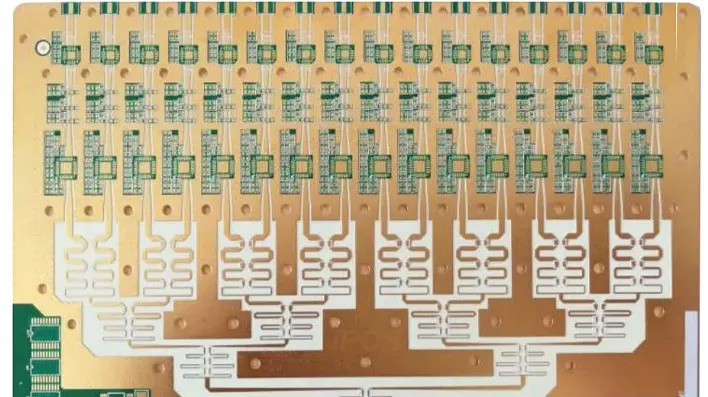
RF PCBs
RF PCB Manufacturing Process Overview
The RF PCB manufacturing services encompass multiple specialized processes requiring precise control and monitoring throughout production. Understanding these processes enables better supplier evaluation and quality expectations alignment.
Substrate Preparation and Lamination
Initial substrate preparation involves precise cleaning procedures to remove contamination while preserving material properties. The lamination process requires controlled temperature profiles, pressure application, and cooling rates specific to each substrate type. RF PCB materials selection directly impacts processing parameters and final performance characteristics.
Drilling and Via Formation
RF applications frequently require specialized via structures including blind vias, buried vias, and microvias. The drilling process must minimize resin smear while maintaining hole wall quality for reliable plating adhesion. Advanced manufacturers utilize laser drilling for small diameter vias and mechanical drilling for larger holes, with each process optimized for specific RF PCB characteristics.
Pattern Formation and Etching
Circuit pattern formation requires photoresist systems capable of fine line resolution while maintaining edge definition quality. The etching process must provide consistent line width control across the panel while minimizing undercutting that affects impedance calculations.
Selecting the Right RF PCB Supplier
Supplier selection methodology should incorporate technical capabilities assessment, quality system evaluation, and commercial considerations. The best RF PCB manufacturer for 5G and IoT applications must demonstrate specific competencies aligned with next-generation wireless requirements.
Technical Assessment Framework
Frequency Range Capabilities:
- Sub-6GHz: Standard Rogers RO4000 series processing
- 6-40GHz: Advanced PTFE substrate handling and precision processing
- Millimeter-wave: Specialized equipment and measurement capabilities
Volume and Scalability:
- Prototype quantities: 1-10 pieces with rapid turnaround
- Small series production: 10-100 pieces with cost optimization
- Volume production: 100+ pieces with automated processing and testing
Commercial Evaluation Criteria
Delivery Performance:
- Standard lead times for prototype and production quantities
- Express delivery capabilities for urgent requirements
- On-time delivery history and performance metrics
Technical Support:
- Design for manufacturability (DFM) review capabilities
- Application engineering support for complex requirements
- Post-delivery technical assistance and problem-solving support
Haoyue Electronics: Your Trusted RF & Microwave PCB Manufacturing Partner
As the RF electronics industry continues advancing toward higher frequencies and more demanding applications, selecting an experienced manufacturing partner becomes increasingly critical. Haoyue Electronics has established comprehensive capabilities specifically designed to meet the evolving needs of RF and microwave applications across multiple industry sectors.
Our ISO certified RF PCB manufacturer capabilities include:
- Advanced Rogers substrate processing with full material traceability
- Precision impedance control within ±3% tolerance for critical applications
- Complete testing infrastructure including VNA measurements up to 67GHz
- Comprehensive assembly services from prototyping through volume production
- Dedicated engineering support for DFM optimization and cost reduction strategies
- Certified quality management systems ensuring consistent delivery performance
Whether you require prototype development for emerging 5G applications or volume production for established wireless products, our team provides the technical expertise and manufacturing capabilities necessary for successful project execution. Contact our engineering team to discuss your specific RF PCB requirements and discover how our capabilities can support your next-generation wireless designs.
Frequently Asked Questions
1. What makes RF PCB manufacturing different from standard PCB fabrication?
RF PCB manufacturing requires specialized materials with controlled dielectric properties, precise impedance control within tight tolerances, and advanced testing capabilities. The RF PCB manufacturer must handle PTFE-based substrates, implement strict process controls for high-frequency performance, and possess measurement equipment capable of verifying electrical characteristics at operating frequencies.
2. How do I select a reliable RF PCB manufacturer for my project?
Focus on technical capabilities matching your frequency requirements, quality certifications relevant to your industry, and manufacturing capacity aligned with your volume needs. Evaluate the RF PCB supplier based on material handling expertise, testing infrastructure, and demonstrated experience with similar applications. Request capability documentation and consider conducting supplier audits for critical projects.
3. What quality standards should I expect from an RF PCB manufacturer?
Professional RF PCB manufacturing services should include ISO 9001:2015 certification as a minimum requirement, along with relevant industry-specific standards. The manufacturer should provide complete traceability documentation, impedance test reports, and material certifications. Statistical process control implementation and continuous improvement programs indicate mature quality management systems.
4. Can RF PCB manufacturers handle both fabrication and assembly services?
Many experienced RF PCB assembly providers offer integrated services covering both fabrication and component assembly. This approach provides better control over impedance integrity, reduces handling risks, and simplifies supply chain management. Verify that the manufacturer maintains proper ESD controls and possesses appropriate equipment for RF component placement and soldering.
5. What delivery times should I expect for RF PCB manufacturing?
Prototype quantities typically require 5-10 business days depending on complexity and material availability. Production quantities may require 2-4 weeks based on panel utilization and testing requirements. The best RF PCB manufacturer for 5G and IoT applications often provides expedited services for urgent requirements while maintaining quality standards through established process controls.