
Introduction to Rigid-Flex PCB Manufacturing
Understanding Rigid-Flex PCB Architecture
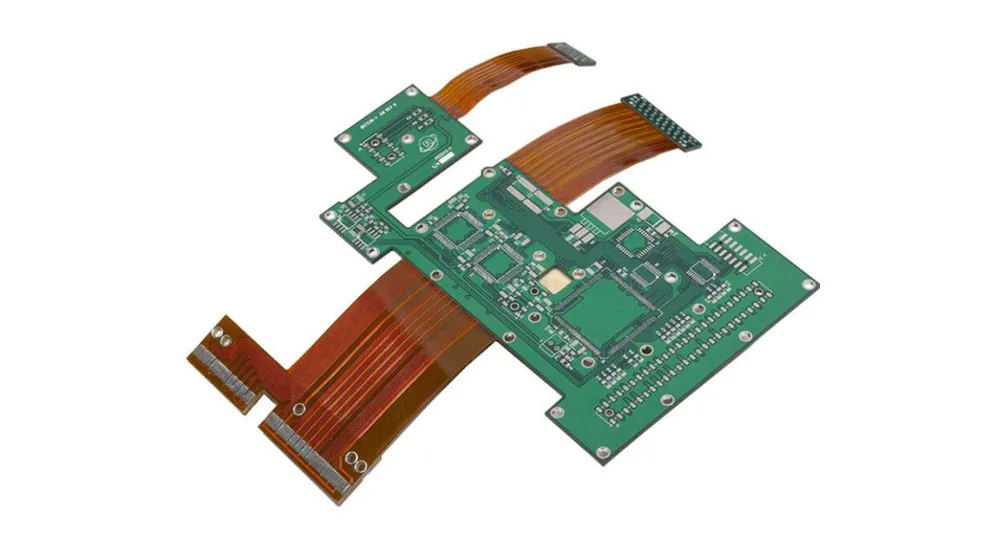
Rigid-flex printed circuit boards combine the mechanical stability of rigid PCBs with the flexibility of flexible circuits, creating a single interconnected structure that eliminates the need for separate connectors and cables. This hybrid technology enables three-dimensional packaging solutions that significantly reduce assembly complexity while improving signal integrity and mechanical reliability.
The rigid-flex PCB manufacturing process involves carefully orchestrated integration of multiple substrate materials, adhesive systems, and specialized fabrication techniques. Unlike traditional rigid PCB manufacturing, the process must account for dynamic flexing requirements, material property transitions, and complex layer stack-up configurations that demand precise control at every manufacturing stage.
Key Manufacturing Advantages
Modern rigid-flex PCB manufacturing offers substantial advantages over conventional PCB assembly methods. The elimination of interconnect cables reduces potential failure points by up to 75%, while the integrated design approach can decrease overall assembly volume by 60% or more. Additionally, the manufacturing process enables improved electromagnetic interference shielding and enhanced signal transmission characteristics across flex regions.
Material Selection and Layer Stack-up Design
Substrate Material Properties
The foundation of successful rigid-flex PCB manufacturing lies in optimal material selection that balances electrical performance, mechanical durability, and thermal stability. The manufacturing process typically employs polyimide films for flexible sections due to their excellent thermal stability, low dielectric constant, and superior flex-life characteristics.
| Material Type | Typical Properties | Manufacturing Considerations |
|---|---|---|
| Polyimide Film | Dielectric constant: 3.4-3.5 | Requires controlled lamination temperatures |
| Adhesiveless Polyimide | Higher flexibility, reduced thickness | Demands precise etching parameters |
| FR-4 Rigid Sections | Standard electrical properties | Standard processing compatibility |
| Coverlay Materials | Protection and insulation | Critical for flex region durability |
Advanced Layer Stack-up Engineering
The rigid-flex PCB manufacturing process requires sophisticated layer stack-up engineering that considers material transitions, impedance control, and thermal expansion matching. Manufacturers must carefully design transition zones where rigid and flexible sections meet, typically incorporating tapered transitions to minimize stress concentrations during flexing operations.
Critical design parameters include copper weight distribution, adhesive selection, and via placement strategies. The manufacturing process often employs varying copper weights across different sections, with thinner copper in flex regions to maintain flexibility while ensuring adequate current carrying capacity in rigid sections.
Adhesive Systems and Bonding Technologies
Modern rigid-flex PCB manufacturing utilizes several adhesive technologies, each offering distinct processing characteristics and performance benefits. Acrylic adhesives provide excellent flexibility and temperature resistance, while modified epoxy systems offer superior mechanical strength for high-reliability applications. The manufacturing process selection depends on specific application requirements, including operating temperature ranges, flex cycle requirements, and chemical exposure conditions.
Critical Manufacturing Stages in Rigid-Flex PCB Production
Precision Drilling and Via Formation
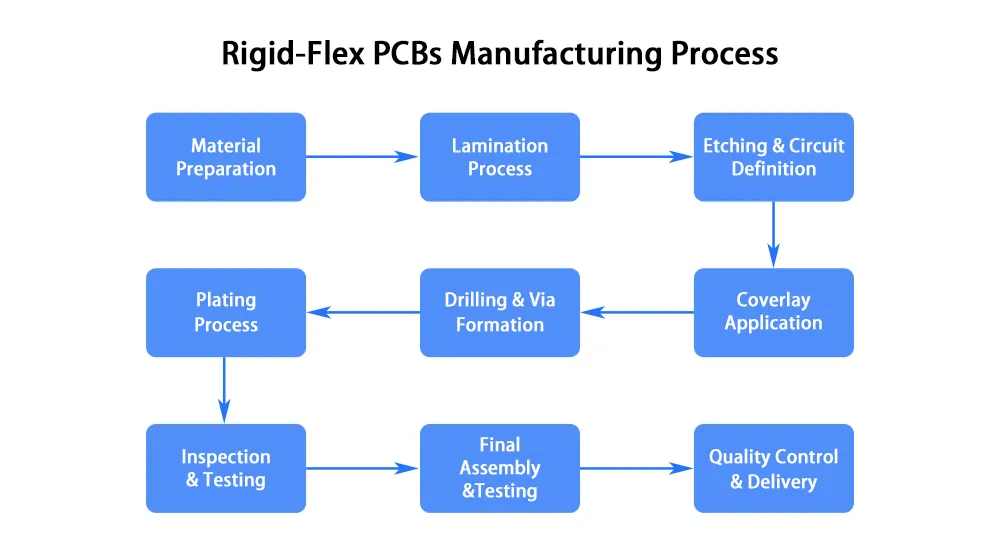
The rigid-flex PCB manufacturing process begins with precision drilling operations that must accommodate varying material thicknesses and different substrate properties. Specialized drill bits and optimized drilling parameters ensure clean hole formation across material transitions without delamination or burring.
Via formation in rigid-flex manufacturing requires particular attention to aspect ratios and plating uniformity. The process typically employs:
- Mechanical drilling for standard vias in rigid sections
- Laser drilling for microvias and precision holes in flexible regions
- Sequential build-up techniques for high-density interconnect requirements
- Controlled depth drilling for blind and buried via structures
Advanced Plating Processes
Electroplating in rigid-flex PCB manufacturing demands specialized techniques to ensure uniform copper distribution across varying substrate materials and geometries. The manufacturing process employs pulse plating and additive chemistry controls to achieve consistent copper thickness while maintaining flexibility in flex regions.
The plating process must address several critical challenges including current distribution optimization, chemical compatibility across different substrate materials, and thermal expansion management during processing. Advanced manufacturers utilize real-time monitoring systems to maintain precise control over plating parameters throughout the manufacturing cycle.
Etching and Circuit Definition
Circuit pattern definition in rigid-flex PCB manufacturing requires sophisticated etching processes that account for different etch rates across various substrate materials. The manufacturing process typically employs alkaline etching chemistries with carefully controlled agitation and temperature profiles to ensure uniform circuit definition while preventing over-etching in flexible sections.
Advanced Processing Techniques and Quality Control
Lamination Process Optimization
The lamination stage represents perhaps the most critical phase in rigid-flex PCB manufacturing. The process requires precise control of temperature, pressure, and timing to achieve proper adhesion between layers while maintaining flexibility characteristics. Modern manufacturing employs multi-stage lamination cycles with specific pressure and temperature profiles optimized for each material combination.
Key lamination parameters include:
- Temperature ramping rates tailored to material thermal properties
- Pressure application optimized for adhesive flow and air evacuation
- Cool-down profiles designed to minimize internal stress development
- Vacuum processing to eliminate voids and ensure complete adhesion
Coverlay Application and Protection
Coverlay application in rigid-flex PCB manufacturing provides essential protection for flexible circuits while maintaining bend radius capabilities. The manufacturing process employs specialized adhesive coverlay materials that bond securely to the circuit while allowing repeated flexing without delamination.
The application process requires precise registration and controlled lamination conditions to prevent wrinkles, air entrapment, or adhesive squeeze-out that could compromise flexibility or electrical performance.
Comprehensive Quality Control Systems
Modern rigid-flex PCB manufacturing incorporates sophisticated quality control measures throughout the production process. Automated optical inspection systems verify circuit integrity, layer registration, and dimensional accuracy, while electrical testing validates signal integrity and impedance characteristics across flex regions.
Design Considerations for Manufacturing Optimization
Bend Radius and Flex Life Optimization
Successful rigid-flex PCB manufacturing requires careful consideration of minimum bend radius requirements and expected flex life cycles. The manufacturing process must accommodate design specifications that ensure adequate copper flexibility while maintaining electrical continuity throughout the product lifecycle.
Design guidelines for manufacturing optimization include:
- Minimum bend radius typically 6-10 times the flexible section thickness
- Copper weight selection balanced between current capacity and flexibility
- Via placement positioned outside primary flex zones when possible
- Stiffener integration for mechanical support in critical areas
Manufacturing Tolerances and Process Windows
The rigid-flex PCB manufacturing process requires tighter tolerances than conventional PCB fabrication, particularly in transition zones between rigid and flexible sections. Manufacturers must establish process windows that accommodate material property variations while maintaining dimensional accuracy and electrical performance.
Critical tolerance parameters include layer-to-layer registration, hole positioning accuracy, and trace width consistency across different substrate materials. Advanced manufacturing facilities employ statistical process control methods to monitor these parameters continuously and maintain optimal production yields.
Cost Optimization Strategies
Effective rigid-flex PCB manufacturing balances performance requirements with cost considerations through strategic design optimization. The manufacturing process can be optimized by minimizing layer count, standardizing material selections, and designing for manufacturability principles that reduce processing complexity.
Industry Applications and Future Trends
Emerging Market Applications
The rigid-flex PCB manufacturing process continues to evolve to meet demanding requirements in aerospace, medical devices, automotive electronics, and consumer electronics. Each application segment presents unique manufacturing challenges that drive innovation in materials, processes, and quality control systems.
Advanced applications increasingly demand higher layer counts, finer trace geometries, and improved thermal management capabilities. The manufacturing process must evolve to accommodate these requirements while maintaining cost-effectiveness and production scalability.
Technology Integration and Automation
Future developments in rigid-flex PCB manufacturing focus on increased automation, artificial intelligence integration, and real-time process monitoring capabilities. These advances promise improved consistency, reduced manufacturing cycle times, and enhanced quality control throughout the production process.
Partnering with Expert Rigid-Flex PCB Manufacturers
The complexity of rigid-flex PCB manufacturing demands expertise that extends far beyond conventional PCB fabrication capabilities. Success requires deep understanding of material science, process optimization, and quality control systems specifically tailored to hybrid rigid-flex architectures.
Haoyue Electronics brings over two decades of specialized experience in advanced rigid-flex PCB manufacturing and assembly services. Our state-of-the-art facility combines cutting-edge manufacturing equipment with comprehensive quality control systems to deliver reliable, high-performance rigid-flex solutions for demanding applications.
Our engineering team works closely with clients to optimize designs for manufacturability, ensuring optimal performance while maintaining cost-effectiveness. From prototype development through high-volume production, we provide complete rigid-flex PCB manufacturing solutions backed by rigorous quality standards and responsive customer support.
Contact Haoyue Electronics today to discuss your rigid-flex PCB requirements and discover how our advanced manufacturing capabilities can accelerate your product development timeline while ensuring exceptional quality and reliability.