
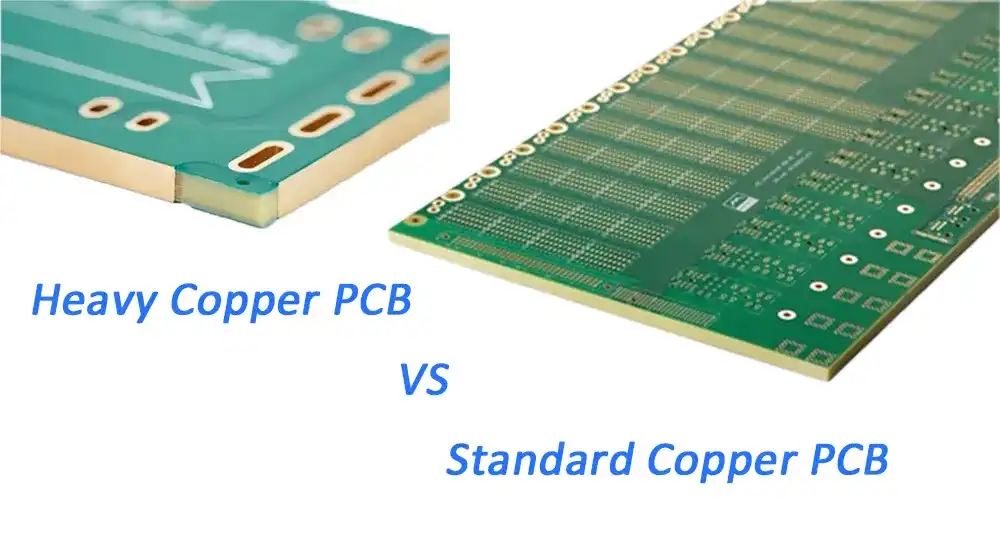
The selection between heavy copper PCBs and standard copper PCBs represents a critical engineering decision that directly impacts system performance, manufacturing costs, and long-term reliability. This analysis provides a comprehensive comparison framework to support informed decision-making based on quantitative performance metrics, cost considerations, and application requirements.
Key Comparison Points:
- Copper thickness: Standard (1-2 oz/sq ft) vs Heavy Copper (3-20+ oz/sq ft)
- Current capacity: 10-15x improvement with heavy copper implementations
- Thermal performance: 50-80% thermal resistance reduction in heavy copper designs
- Manufacturing cost: 2-4x increase for heavy copper PCBs
- Application focus: Standard for general electronics vs Heavy copper for high-power systems
Core Technical Specifications Comparison
Copper Thickness and Weight Specifications
Standard copper PCBs utilize copper weights ranging from 0.5 to 2 ounces per square foot, with 1-ounce copper representing the most common implementation in commercial electronics. This translates to copper thickness of approximately 0.7 to 2.8 mils. Heavy copper PCBs begin at 3 ounces per square foot and extend to 20 ounces or higher for specialized applications, corresponding to copper thickness ranging from 4.2 to 28 mils.
The fundamental specification difference drives all subsequent performance variations between these technologies. Heavy copper implementations require copper thickness increases of 300-1000% compared to standard designs, creating proportional improvements in electrical and thermal characteristics while introducing corresponding manufacturing complexities.
Electrical Characteristics and Performance Metrics
Current carrying capacity represents the most significant performance differential between standard and heavy copper PCBs. Standard 1-ounce copper traces handle approximately 1 ampere per millimeter of trace width under typical operating conditions. Heavy copper traces of 6-ounce thickness support 6-8 amperes per millimeter, while 12-ounce implementations can handle 12-15 amperes per millimeter of trace width.
Electrical resistance characteristics demonstrate inverse relationships to copper thickness, with 6-ounce heavy copper traces exhibiting approximately 85% lower resistance compared to equivalent 1-ounce standard copper traces. This resistance reduction translates to proportional improvements in power efficiency and voltage regulation performance, particularly significant in low-voltage, high-current applications where voltage drop margins are critical.
Thermal Management Performance Comparison
Thermal resistance characteristics show substantial improvements in heavy copper implementations due to increased thermal mass and enhanced heat spreading capabilities. Standard copper PCBs typically exhibit thermal resistance values of 60-80°C/W for representative trace geometries. Heavy copper designs achieve thermal resistance values of 15-35°C/W depending on copper thickness, representing 50-80% thermal resistance reductions.
Heat dissipation capacity improvements enable component operation at higher power levels without external heat sinking requirements. Standard copper PCBs require external thermal management for components exceeding 2-3 watts per square inch, while heavy copper implementations can handle 8-12 watts per square inch through direct PCB heat spreading.
Performance Characteristics Detailed Analysis
Current Density and Power Handling Capabilities
The current density performance comparison reveals fundamental differences in power distribution network design requirements. Standard copper PCBs operate effectively at current densities up to 20 amperes per square inch of copper cross-section. Heavy copper PCBs maintain acceptable performance at current densities exceeding 50 amperes per square inch, enabling more compact power distribution designs.
Power handling improvements scale directly with copper thickness increases. A 6-ounce heavy copper power plane can handle 6-8 times the power throughput of equivalent 1-ounce standard copper planes while maintaining comparable temperature rise characteristics. This scaling relationship enables system designs with significantly higher power density requirements.
Signal Integrity and Electromagnetic Performance
Impedance control characteristics differ significantly between standard and heavy copper implementations. Standard copper PCBs achieve controlled impedances of 25-150 ohms with trace width variations of 50-500 mils depending on stackup configuration. Heavy copper PCBs require wider trace geometries to achieve equivalent impedance values, with 6-ounce copper typically requiring 1.5-2x trace width compared to 1-ounce implementations.
Ground plane performance improvements in heavy copper designs contribute to enhanced signal integrity through reduced ground bounce and improved electromagnetic interference shielding. The increased conductor mass provides superior current return paths and more stable reference potentials for high-speed digital signals.
Mechanical Strength and Reliability Characteristics
Mechanical properties comparison reveals significant structural advantages for heavy copper PCBs. Standard copper PCBs exhibit tensile strength values of 200-250 MPa for copper foil, while heavy copper implementations achieve 250-300 MPa due to improved copper grain structure from electroplating processes. This strength improvement contributes to enhanced reliability under thermal cycling and mechanical stress conditions.
Multilayer PCB design considerations differ substantially between standard and heavy copper implementations due to thermal expansion coefficient variations. Heavy copper designs require enhanced mechanical analysis to accommodate the increased thermal mass and thermal expansion mismatch effects between copper and substrate materials.
Manufacturing Process and Cost Analysis
Fabrication Complexity Comparison
Manufacturing process requirements demonstrate significant differences between standard and heavy copper PCB production. Standard copper PCBs utilize conventional electroplating processes with plating times of 30-60 minutes to achieve target copper thickness. Heavy copper PCBs require electroplating cycles of 4-8 hours with multiple intermediate process steps, representing 6-10x manufacturing time increases.
Heavy copper PCB manufacturing processes require specialized equipment capabilities including enhanced current capacity electroplating systems, advanced etching chemistry, and modified drilling parameters. These process modifications contribute directly to increased manufacturing costs and extended production lead times.
Cost Structure Analysis
Direct material costs for heavy copper PCBs increase proportionally with copper weight, representing 40-60% of the total cost differential. A 6-ounce heavy copper PCB requires 6x the copper material compared to 1-ounce standard copper implementations. Processing cost increases of 150-300% result from extended electroplating times, specialized chemistry requirements, and enhanced quality control measures.
Total manufacturing cost comparisons show heavy copper PCBs ranging from 2x cost for 3-ounce implementations to 4x cost for 12-ounce designs compared to equivalent standard copper PCBs. However, system-level cost analysis often demonstrates favorable cost-effectiveness for heavy copper designs when reduced component count, eliminated heat sinks, and improved reliability are considered.
Quality Control and Testing Requirements
Quality assurance requirements differ substantially between standard and heavy copper PCB production. Standard copper PCBs require copper thickness verification at 5-10 measurement points per panel using standard cross-sectional analysis techniques. Heavy copper PCBs demand copper thickness verification at 15-25 points per panel with enhanced measurement accuracy requirements due to the increased thickness variations possible in heavy copper electroplating.
Testing protocols for heavy copper PCBs include current carrying capacity validation, thermal cycling verification, and mechanical stress testing not typically required for standard copper implementations. These enhanced testing requirements contribute to extended production cycles and increased quality assurance costs.
Application Selection and Engineering Guidelines
High-Power Electronics Applications
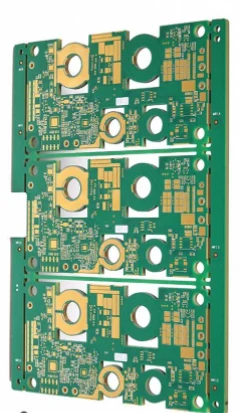
Power electronics applications represent the primary domain where heavy copper PCBs demonstrate clear advantages over standard copper implementations. Motor drive systems, power supplies, and renewable energy inverters require current handling capabilities that exceed standard copper PCB limitations. Applications requiring current levels above 10 amperes per trace or power dissipation exceeding 5 watts per component typically justify heavy copper PCB implementation.
Heavy copper PCB design becomes essential for electric vehicle powertrains, industrial motor controllers, and high-power LED drivers where current levels of 50-500 amperes are common. The thermal management advantages enable compact designs that would be impossible with standard copper PCB technology.
Cost-Sensitive Consumer Electronics
Standard copper PCBs remain the preferred choice for cost-sensitive consumer electronics applications where current requirements remain below 5 amperes and power dissipation stays within 2-3 watts per component. Mobile devices, consumer audio equipment, and general-purpose digital systems achieve adequate performance with standard copper implementations while maintaining competitive cost structures.
The decision threshold typically occurs when external heat sinking costs, additional copper layers, or enhanced thermal design requirements make heavy copper PCBs cost-competitive despite higher PCB manufacturing costs. This threshold varies by application but generally occurs when total thermal management costs exceed 1.5-2x the heavy copper PCB premium.
Industrial and Automotive Systems
Industrial automation and automotive electronics applications demonstrate mixed requirements that necessitate careful analysis of performance benefits versus cost implications. High-frequency PCB applications and advantages in industrial systems often require heavy copper power planes combined with standard copper signal layers to optimize both power distribution and signal integrity performance.
Automotive applications increasingly favor heavy copper PCBs for powertrains and charging systems due to reliability requirements and harsh environmental conditions. The enhanced mechanical strength and thermal stability justify the cost premium in applications where field failures carry significant warranty and safety implications.
Selection Decision Matrix
Engineering selection criteria should evaluate current requirements, thermal constraints, cost targets, and reliability requirements to determine optimal copper thickness. Applications requiring current densities below 15 amperes per square inch and operating temperatures below 85°C typically perform adequately with standard copper PCBs. Current densities above 25 amperes per square inch or operating temperatures exceeding 100°C generally require heavy copper implementations.
The selection decision becomes complex in intermediate performance ranges where system-level optimization may favor heavy copper PCBs despite higher PCB costs. Enhanced multilayer PCB manufacturing processes enable hybrid designs combining standard copper signal layers with heavy copper power planes to optimize performance and cost trade-offs.
Engineering Recommendations and Best Practices
Performance-Based Selection Criteria
The selection between standard and heavy copper PCBs should primarily focus on quantitative performance requirements rather than arbitrary technology preferences. Applications requiring sustained current levels above 15 amperes per trace, power dissipation exceeding 5 watts per square inch, or operating temperatures above 100°C typically justify heavy copper implementation regardless of cost considerations.
Thermal analysis represents the critical evaluation tool for determining copper requirements. Standard copper PCBs maintain adequate performance when component junction temperatures remain below 125°C under worst-case operating conditions. Heavy copper PCBs become necessary when thermal modeling indicates junction temperatures exceeding 140°C with standard copper implementations.
Cost Optimization Strategies
Cost-effective heavy copper PCB implementation requires careful analysis of copper distribution to minimize unnecessary copper thickness in non-critical areas. Mixed copper weight designs utilizing heavy copper for power distribution and standard copper for signal routing optimize performance while controlling costs. This approach typically reduces heavy copper PCB costs by 20-30% compared to uniform heavy copper implementations.
System-level cost optimization should consider the total cost of ownership including reduced component count, eliminated external heat sinks, improved reliability, and enhanced power efficiency. Heavy copper PCBs often demonstrate favorable life-cycle costs despite higher initial PCB costs when these system-level benefits are quantified.
Implementation Guidelines
Successful heavy copper PCB implementation requires early consideration of manufacturing constraints and design rule modifications. Minimum trace width and spacing requirements increase proportionally with copper thickness, requiring layout modifications compared to standard copper designs. Via design rules must accommodate increased aspect ratios and enhanced plating requirements associated with heavy copper implementations.
Rigid PCB manufacturing processes require coordination between design and manufacturing teams to ensure heavy copper PCB designs remain within manufacturing capabilities while achieving performance requirements. This coordination becomes critical for achieving optimal cost-effectiveness and production yields in heavy copper PCB implementations.
Choose Haoyue Electronics for Your Heavy Copper PCB Needs
As heavy copper PCB technology demands precise manufacturing expertise and advanced assembly capabilities, selecting a reliable partner is essential for achieving optimal performance and product reliability. Haoyue Electronics offers:
-
Comprehensive Manufacturing & Assembly Expertise: Specializing in both standard and heavy copper PCBs with advanced electroplating and multilayer stackup capabilities.
-
State-of-the-Art Facilities: Equipped with cutting-edge production lines and rigorous quality control systems to ensure consistent, high-quality output.
-
Engineering Collaboration: Experienced engineers work closely with customers to optimize designs for manufacturability, cost efficiency, and peak performance.
-
Thermal & Mechanical Excellence: Proven capability in delivering superior thermal management and enhanced mechanical durability for demanding applications.
-
Diverse Industry Experience: Serving automotive, industrial, aerospace, and high-power electronics sectors with tailored heavy copper PCB solutions.
-
Commitment to Reliability: Focused on helping customers bring robust, high-performance electronic products to market efficiently and reliably.