
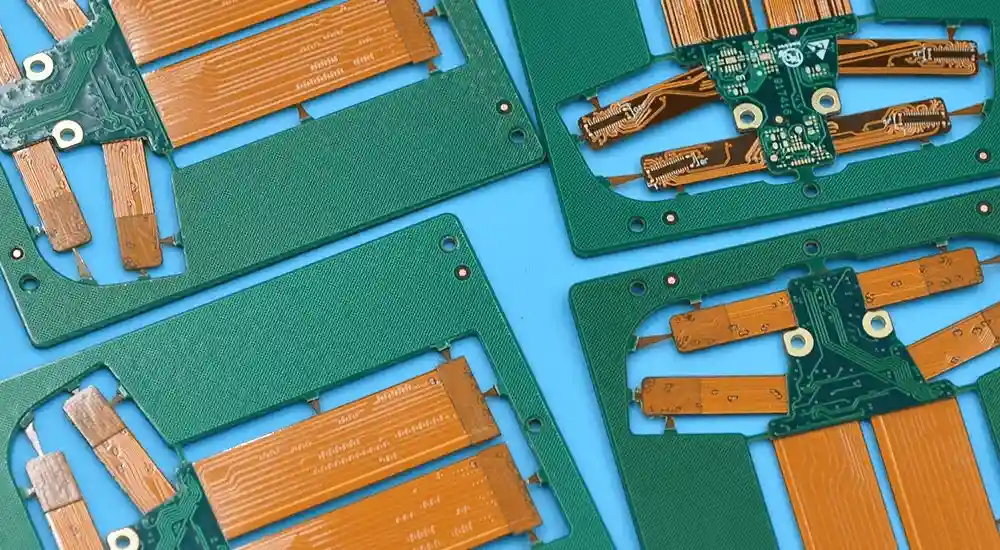
As electronic devices continue to shrink while offering greater functionality, HDI flex PCBs have emerged as a superior alternative to conventional flexible circuits. By leveraging microvias as small as 50 micrometers and advanced sequential lamination techniques, these boards enable exceptional component density without compromising the flexibility essential for modern designs.
At Haoyue Electronics, we specialize in the production of high-reliability HDI flex PCBs tailored to the rigorous requirements of aerospace, medical, automotive, and consumer electronics sectors. Our capabilities span from simple single-layer flexible circuits to intricate sixteen-layer assemblies, built on ultra-thin polyimide substrates (down to 12.5 micrometers) and incorporating advanced features such as stacked microvias and via-in-pad structures.
Technical Architecture and Manufacturing Capabilities
Microvia Technology and Interconnect Density
HDI flex PCB technology distinguishes itself through the implementation of laser-drilled microvias that enable significant increases in routing density compared to conventional flexible circuits. These microvias, typically ranging from 35 to 100 micrometers in diameter depending on dielectric thickness, support aspect ratios optimized for reliability while maintaining the mechanical flexibility required for dynamic applications.
The integration of microvia technology with flexible substrates creates opportunities for implementing blind vias, buried vias, and stacked microvia configurations that maximize interconnect efficiency. Copper-filled via technology ensures superior electrical and thermal performance while enabling via-in-pad designs that further enhance component density and routing flexibility.
Sequential Lamination and Build-Up Processes
Advanced HDI flex designs employ sequential lamination techniques that enable the creation of complex multilayer structures through controlled build-up processes. This manufacturing approach begins with a flexible core substrate and progressively adds dielectric and conductor layers with precise registration control to maintain dimensional accuracy throughout the assembly process.
The sequential build-up methodology supports various stackup configurations, including traditional build-up structures and advanced any-layer HDI designs where all interconnections utilize laser-drilled microvias. This flexibility in construction enables designers to optimize electrical performance while minimizing layer count and overall thickness.
Material Systems and Substrate Selection
HDI flex PCB construction utilizes high-performance polyimide films that provide exceptional thermal stability, chemical resistance, and mechanical durability. Substrate options include polyimide films ranging from 12.5 to 125 micrometers in thickness, with adhesiveless constructions available for ultra-thin applications requiring maximum flexibility.
Conductor systems employ copper foils from 5 to 107 micrometers thickness, enabling fine-line geometries essential for high-density routing while maintaining adequate current-carrying capacity. Surface finish options include electroless nickel immersion gold, electroless nickel electroless palladium immersion gold, and organic solderability preservative, each selected based on specific application requirements.
Design Advantages and Performance Benefits
Enhanced Routing Density and Space Optimization
HDI flex PCBs provide substantial improvements in routing density through the effective utilization of microvias and advanced layer stackup designs. The shorter interconnect paths achievable with microvia technology enable more efficient use of available routing space while reducing overall circuit board dimensions. Studies indicate that HDI flex designs can achieve up to 40% cost reduction compared to conventional flexible circuits through improved space utilization and reduced layer count requirements.
The ability to route traces on internal layers beneath microvia pads creates additional design space that enables more complex circuit topologies within constrained form factors. This routing flexibility proves particularly valuable for applications requiring high component density while maintaining mechanical flexibility for three-dimensional packaging configurations.
Signal Integrity and Electrical Performance
The implementation of microvia technology in flexible substrates provides significant advantages for high-frequency applications through reduced via inductance and improved signal transmission characteristics. Shorter via lengths minimize parasitic effects while enabling more controlled impedance environments that support advanced signaling requirements.
Microvia technology reduces crosstalk and noise in high-speed circuits by enabling shorter signal paths and improved ground plane continuity. The elimination of through-hole via stubs enhances signal integrity for applications operating at gigahertz frequencies, making HDI flex technology suitable for advanced communication systems and high-speed data processing applications.
Thermal Management and Reliability Enhancement
HDI flex PCBs demonstrate superior thermal performance through reduced z-axis thermal stress between adjacent layers compared to conventional flexible circuits. The microvia structures provide improved thermal conduction paths that enhance heat dissipation capabilities while maintaining mechanical flexibility requirements.
The reduced thermal stress characteristics of microvia technology contribute to enhanced long-term reliability, particularly in applications subject to thermal cycling or high-power operation. This thermal advantage enables the design of more robust circuits that maintain performance integrity throughout extended operational lifecycles.

Applications and Industry Requirements
Consumer Electronics and Portable Devices
The consumer electronics market drives continuous innovation in HDI flex PCB technology, particularly for applications requiring extreme miniaturization and complex three-dimensional configurations. Smartphones, tablets, wearable devices, and wireless earphones represent primary application areas where HDI flex technology enables unprecedented levels of integration and functionality.
Design requirements for consumer applications emphasize ultra-thin profiles, often below 0.5 millimeters total thickness, combined with high component density to support advanced features within compact form factors. The technology must accommodate fine-pitch ball grid array packages while maintaining cost-effectiveness for high-volume production.
Medical Device Applications
Medical electronics applications impose stringent reliability and biocompatibility requirements that challenge conventional circuit board technologies. HDI flex PCBs provide unique advantages for medical devices including pacemakers, implantable sensors, and diagnostic equipment where space constraints, reliability requirements, and biocompatibility considerations are paramount.
Medical device design considerations include compliance with ISO 13485 quality standards, biocompatible material selection, and long-term reliability requirements often exceeding ten years of continuous operation. The polyimide substrate material offers excellent biocompatibility characteristics while providing superior resistance to sterilization processes including gamma radiation and chemical sterilization methods.
Aerospace and Defense Systems
Aerospace applications demand exceptional performance under extreme environmental conditions including wide temperature ranges, vibration resistance, and radiation tolerance. HDI flex PCBs must maintain precise electrical characteristics while withstanding temperature cycling from negative 55 degrees Celsius to positive 125 degrees Celsius and meeting stringent outgassing requirements for space applications.
Defense applications require compliance with military specifications including MIL-STD-202 for environmental testing and specialized requirements for electromagnetic interference resistance. The technology must demonstrate consistent performance under high-acceleration conditions and maintain signal integrity in electronically challenging environments.
Automotive Electronics Integration
The automotive industry increasingly relies on HDI flex PCB technology for applications ranging from advanced driver assistance systems to infotainment platforms. The harsh automotive environment requires robust designs that maintain performance across extended temperature ranges while meeting automotive electronics council qualification standards.
Automotive design requirements emphasize electromagnetic compatibility, vibration resistance, and long-term reliability under conditions including thermal cycling, humidity exposure, and mechanical stress. The technology must support high-speed data transmission for modern automotive communication protocols while maintaining cost-effectiveness for high-volume production.
Manufacturing Process and Quality Standards
Precision Manufacturing and Process Control
HDI flex PCB manufacturing requires sophisticated equipment and precise process control to achieve the dimensional accuracy and quality consistency demanded by advanced applications. Laser drilling systems must maintain positional accuracy within 10 micrometers while controlling via diameter tolerances to ensure reliable electrical and mechanical performance.
Sequential lamination processes require precise temperature and pressure control to achieve proper adhesion between layers while maintaining registration accuracy throughout the build-up sequence. Automated optical inspection systems verify dimensional accuracy and detect potential defects before subsequent processing steps, ensuring consistent quality output.
Quality Assurance and Testing Methodologies
Comprehensive testing protocols ensure HDI flex PCB assemblies meet design specifications and reliability requirements. Electrical testing includes continuity verification, controlled impedance measurement using time-domain reflectometry, and high-frequency characterization for signal integrity validation.
Mechanical testing protocols evaluate flex endurance capabilities, adhesion strength between conductor and substrate interfaces, and dimensional stability under thermal cycling conditions. These tests replicate realistic operating conditions while providing accelerated assessment capabilities that predict long-term performance characteristics.
Environmental Testing and Reliability Assessment
Environmental testing protocols validate HDI flex PCB performance under operating conditions including temperature cycling, humidity exposure, vibration, and shock testing. These assessments ensure the technology meets application-specific requirements while identifying potential failure modes that could impact long-term reliability.
Accelerated aging tests evaluate material stability and electrical performance degradation over extended periods, providing confidence in long-term operational reliability. Statistical process monitoring enables continuous improvement in manufacturing processes while maintaining consistent quality standards.
Future Development and Market Trends
Advanced Material Development
Emerging material technologies promise enhanced performance characteristics for next-generation HDI flex PCB applications. Low-loss dielectric materials enable improved high-frequency performance for fifth-generation wireless communication systems and beyond, while thermally conductive polyimide formulations address thermal management challenges in high-power applications.
Environmental sustainability considerations drive development of biodegradable substrate materials and alternative conductor systems that reduce environmental impact while maintaining performance requirements. These material advances support industry trends toward more sustainable manufacturing practices.
Manufacturing Innovation and Automation
Advanced manufacturing techniques continue expanding HDI flex PCB capabilities while improving production efficiency and quality consistency. Additive manufacturing approaches enable direct printing of conductor patterns and dielectric layers, potentially reducing manufacturing complexity while enabling new design possibilities.
Machine learning applications in automated inspection systems enhance defect detection capabilities while reducing inspection time and improving consistency. Digital manufacturing integration supports Industry 4.0 concepts that optimize production scheduling and quality control processes.
Market Growth and Technology Integration
Market analysis indicates continued strong growth in HDI flex PCB demand driven by expanding applications in internet of things devices, artificial intelligence hardware, and advanced automotive systems. The technology increasingly integrates with emerging technologies including millimeter-wave communication systems and quantum computing interfaces.
The convergence of HDI flex technology with other advanced packaging approaches creates opportunities for system-level optimization that addresses the evolving requirements of next-generation electronic systems. This integration enables more sophisticated design approaches while maintaining the fundamental advantages of flexible circuit technology.
Haoyue Electronics remains committed to advancing HDI flex PCB technology through continued investment in manufacturing capabilities and process innovation. Our expertise in advanced materials, precision manufacturing, and quality assurance ensures customers receive solutions that meet the demanding requirements of modern electronic applications while supporting the development of next-generation products that define technological leadership in their respective markets.