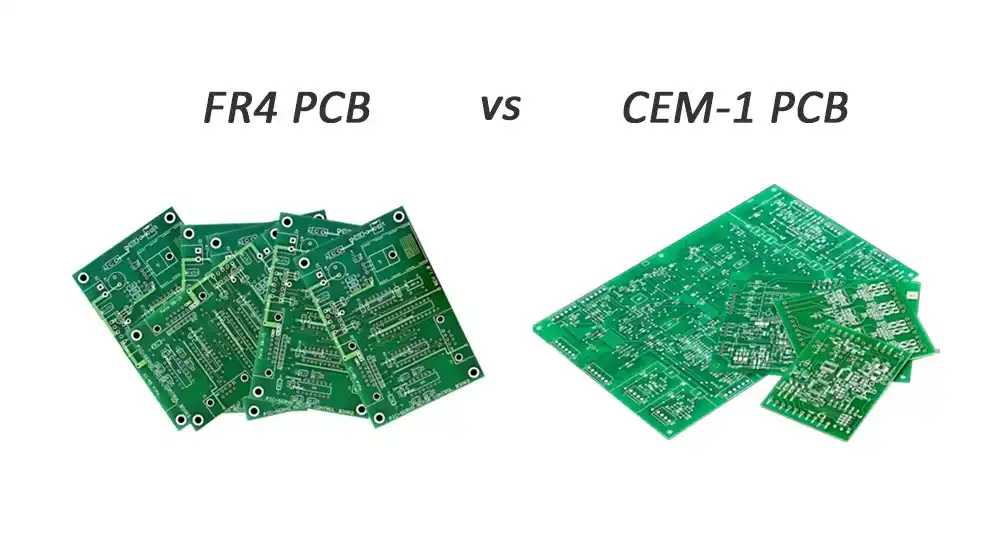
Material Composition Differences
FR4 Construction: Woven fiberglass cloth with flame-retardant epoxy resin delivers superior mechanical strength and dimensional stability. The uniform glass fiber weave ensures consistent electrical properties across all directions.
CEM-1 Construction: Paper core with fiberglass surface layers reduces costs while providing adequate performance for basic applications. The paper core enables easier machining but limits thermal and moisture resistance.
Key Structural Impact: FR4’s isotropic properties maintain consistent strength regardless of direction, while CEM-1’s anisotropic structure varies performance based on grain orientation.
Performance Characteristics Comparison
Mechanical Strength: FR4 delivers superior tensile strength exceeding 300 MPa compared to CEM-1’s 200 MPa rating, providing better reliability under mechanical stress.
Thermal Performance: FR4 operates continuously up to 130°C while CEM-1 limits to 105°C due to paper core constraints.
Moisture Resistance: FR4 absorbs less than 0.15% moisture by weight, significantly outperforming CEM-1’s higher moisture sensitivity from cellulose content.
Electrical Properties: FR4 maintains stable dielectric constants across frequencies, enabling precise impedance control for high-speed applications. CEM-1’s heterogeneous structure creates greater variation, limiting controlled-impedance designs.
Cost Analysis and Manufacturing Economics
Material Pricing: CEM-1 typically costs 20-30% less than equivalent FR4 substrates, making it attractive for budget-conscious consumer electronics.
Manufacturing Costs: CEM-1 reduces drilling and routing expenses through easier machining, while FR4 requires specialized tooling but offers lower defect rates.
Volume Economics: High-volume consumer devices benefit from CEM-1’s cost advantages, whereas precision applications justify FR4’s premium through reduced warranty claims and field failures.
Total Cost Impact: Long-term analysis must consider lifecycle expenses beyond initial material costs, as FR4’s enhanced reliability often offsets higher upfront investment.
Application Selection Guidelines
Choose FR4 When: Applications demand high reliability, elevated temperature operation above 105°C, or precise electrical characteristics. Industrial controls, automotive electronics, and medical devices require FR4’s superior performance.
Choose CEM-1 When: Cost-sensitive applications with moderate performance requirements benefit from economic advantages. Consumer appliances, basic electronic devices, and single-use products perform adequately with CEM-1.
Critical Decision Factors:
- Multilayer Designs: FR4 essential for controlled impedance and complex circuits
- Thermal Cycling: FR4 required for automotive and industrial temperature variations
- Signal Integrity: High-speed digital and RF applications necessitate FR4’s uniform properties
Haoyue Electronics Manufacturing Capabilities
Selecting the optimal PCB material requires partnering with experienced manufacturers who understand both material characteristics and application requirements. Haoyue Electronics combines advanced manufacturing capabilities with comprehensive material expertise to deliver superior PCB solutions across diverse industries.
Our manufacturing facility specializes in both FR4 and CEM-1 processing, enabling optimal material selection for each project’s specific requirements. Advanced equipment and process controls ensure consistent quality regardless of chosen substrate material.
Core Manufacturing Capabilities:
- Multi-layer FR4 PCB production up to 20 layers with precise impedance control
- High-volume CEM-1 manufacturing for cost-sensitive applications
- Advanced surface finish options including ENIG, HASL, and OSP
- Rigid-flex PCB assembly combining FR4 performance with flexible connectivity
- Complete PCB assembly services with automated pick-and-place equipment
- Comprehensive testing and quality assurance protocols
- Design for manufacturability consultation and material selection guidance
Our engineering team provides material selection consultation, helping customers balance performance requirements with cost objectives. Whether your application demands FR4’s superior characteristics or CEM-1’s economic advantages, Haoyue Electronics delivers optimized solutions that meet specifications and budget constraints.
Contact Haoyue Electronics today to discuss your PCB material requirements and discover how our manufacturing expertise can enhance your next electronics project. Our technical team stands ready to provide detailed recommendations based on your specific application needs and performance criteria.