
What is Aluminum PCB
An aluminum PCB, also known as a Metal Core PCB (MCPCB), represents a specialized printed circuit board that utilizes an aluminum substrate as its base layer instead of the traditional FR4 fiberglass material. The primary distinction between aluminum PCBs and conventional FR4 boards lies in their superior thermal conductivity, with aluminum substrates offering thermal conductivity ranging from 1.0 to 8.0 W/mK compared to FR4’s limited 0.3 W/mK.
Definition and Basic Characteristics
The aluminum substrate serves as both a structural foundation and an efficient heat sink, making these boards essential for high-power applications where thermal management is critical. The aluminum base layer typically ranges from 0.8mm to 3.0mm in thickness, providing excellent mechanical stability while maintaining lightweight characteristics.
Key Differences from FR4 PCBs
Unlike traditional FR4 boards that rely on fiberglass for structural support, aluminum PCBs leverage metal’s inherent thermal and mechanical properties. This fundamental difference enables aluminum PCBs to dissipate heat efficiently while maintaining dimensional stability across temperature variations.
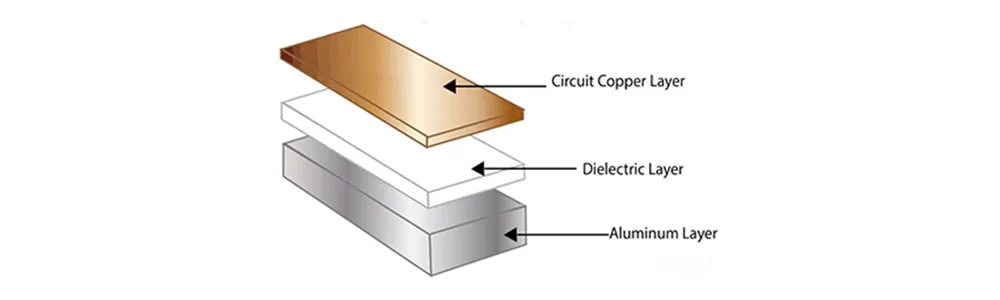
Aluminum PCB Structure
Aluminum PCB Structure and Materials
Aluminum PCBs feature a three-layer construction that optimizes both electrical performance and thermal management. The top copper foil layer, typically ranging from 1 oz to 10 oz (35μm to 350μm), carries electrical signals and components. The middle dielectric layer, usually between 50μm to 200μm thick, provides electrical isolation while maintaining thermal conductivity between 1.0 to 3.0 W/mK.
Layer Composition and Functions
The aluminum base layer forms the foundation, with common alloys including 1060, 3003, and 5052, each offering specific thermal and mechanical properties. The dielectric material selection significantly impacts overall thermal performance, with options including thermally conductive epoxy, polyimide, and specialized ceramic-filled polymers.
Material Thickness and Properties
Material thickness combinations directly affect thermal resistance, with thinner dielectric layers providing better heat transfer but requiring careful consideration of voltage breakdown requirements. Standard aluminum thicknesses include 1.0mm, 1.5mm, 2.0mm, and 3.0mm, selected based on thermal requirements and mechanical constraints.
Types of Aluminum PCB
The aluminum PCB market encompasses several distinct configurations designed for specific application requirements.
Single-Sided Configurations
Single-sided aluminum PCBs represent the most common type, featuring components mounted on one side with the aluminum base providing heat dissipation. These boards excel in LED applications, power supplies, and automotive modules where cost-effectiveness meets thermal performance.
Double-Sided Configurations
Double-sided aluminum PCBs utilize advanced manufacturing techniques to create conductive paths on both sides while maintaining the aluminum substrate’s thermal benefits. These configurations require specialized drilling and plating processes to achieve reliable electrical connections while preserving thermal performance.
Multilayer and Specialty Constructions
Multilayer aluminum PCBs combine multiple circuit layers with aluminum cores, though they present manufacturing challenges and higher costs. Flexible aluminum PCBs incorporate thin aluminum substrates with flexible dielectric materials, enabling applications requiring both thermal management and mechanical flexibility. Hybrid aluminum-FR4 constructions combine aluminum sections for heat-sensitive areas with FR4 regions for complex circuitry, optimizing both thermal and electrical performance.
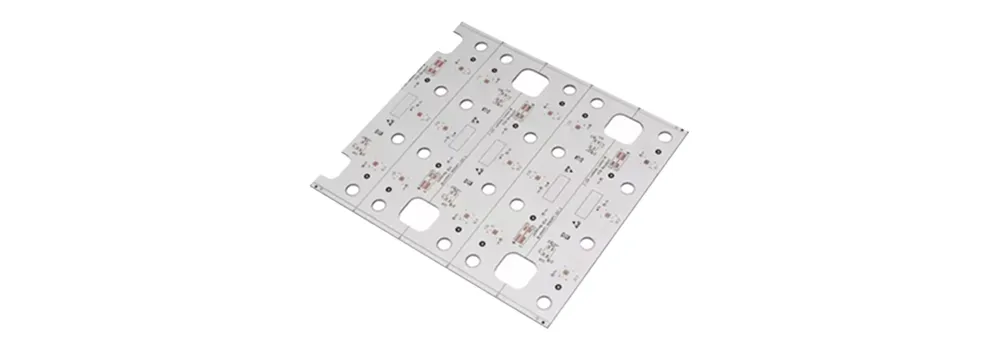
Aluminum PCB Board
Aluminum PCBs Design Guidelines
Effective aluminum PCB design requires careful attention to material selection, thermal management, and electrical performance. The following guidelines help ensure optimal performance while balancing cost considerations.
Copper Thickness and Current Carrying Capacity
Choosing the right copper weight directly impacts the PCB’s ability to handle current. For example, 2 oz copper can support approximately 2–3 amps per millimeter of trace width under typical operating conditions. Proper copper thickness selection ensures reliable operation without excessive heating.
Thermal Via Placement and Sizing
Thermal vias transfer heat from high-power components to the aluminum substrate efficiently. Standard via diameters range from 0.2mm to 0.5mm, with spacing determined by component power dissipation and thermal spreading requirements. Optimizing thermal vias is crucial for effective heat management.
Dielectric Layer Considerations
Dielectric thickness balances thermal conductivity with electrical isolation. Thinner dielectric layers improve heat transfer but may reduce voltage breakdown protection. Designers should also consider the coupling of high-power components to the aluminum base for maximum thermal efficiency.
Component Placement Strategies
High-power components should be positioned in areas with optimal thermal paths to the aluminum substrate. Proper placement reduces hotspots and enhances overall PCB reliability, especially in LED modules, automotive electronics, and power supplies.
Design Rules and Cost Optimization
Design rules include minimum trace widths, spacing, and drill specifications, considering the challenges of drilling aluminum substrates. Cost optimization requires balancing copper weight, aluminum thickness, and surface finish requirements against performance specifications.
Aluminum PCB Manufacturing Process
The aluminum PCB manufacturing process involves several specialized steps to ensure both electrical performance and thermal efficiency. Each stage requires careful control to maintain quality and reliability.
- Aluminum Substrate Preparation: The process begins with aluminum substrate preparation, including surface cleaning to remove impurities and oxide treatment to improve dielectric adhesion.
- Dielectric Layer Application: The dielectric layer is applied under precise temperature and pressure control to achieve uniform thickness and optimal thermal conductivity.
- Copper Foil Lamination: Copper foil lamination follows specialized procedures to accommodate the differing thermal expansion coefficients of copper and aluminum, ensuring strong adhesion and mechanical stability.
- Drilling Operations: Drilling requires carbide tools and carefully controlled feed rates to handle the varying hardness of copper, dielectric, and aluminum layers while maintaining accuracy.
- Circuit Pattern Etching: Circuit patterns are etched using standard photolithography processes, with exposure and development parameters adjusted to account for aluminum’s thermal properties.
- Surface Treatment and Solder Mask Application: Surface finishing and solder mask application follow conventional PCB processes, with special attention to thermal stress management during curing.
- Quality Control: Quality control includes thermal conductivity testing, electrical isolation verification, mechanical stress testing, and automated optical inspection (AOI) to ensure consistent performance.
Thermal Management in Aluminum PCBs
Aluminum PCBs excel in heat dissipation through multiple mechanisms, making them ideal for high-power and thermally sensitive applications. Effective thermal management ensures component reliability and extends PCB lifespan.
Heat Transfer Mechanisms
Heat is conducted primarily through the aluminum substrate, efficiently spreading localized heat across the board. Thermal resistance is calculated as the series resistance of the copper layer, dielectric layer, and aluminum substrate, guiding material selection and layer design.
Thermal Path Considerations
Designers must understand the path from component junction to the ambient environment. The aluminum base acts as a heat sink, lowering junction temperatures, while thermal interface materials enhance conduction to external heat sinks.
Practical Thermal Management Strategies
- Strategic component placement to minimize hotspots
- Implementation of thermal vias to improve vertical heat transfer
- Consideration of convective and radiative heat dissipation
Applications and Performance Examples
LED aluminum PCBs often reduce junction temperatures by 10–20°C compared to FR4 under equivalent operating conditions. Automotive power electronics can handle power densities exceeding 5 W/in² while maintaining safe operating temperatures. Advanced thermal modeling software assists in optimizing layouts for maximum thermal efficiency.
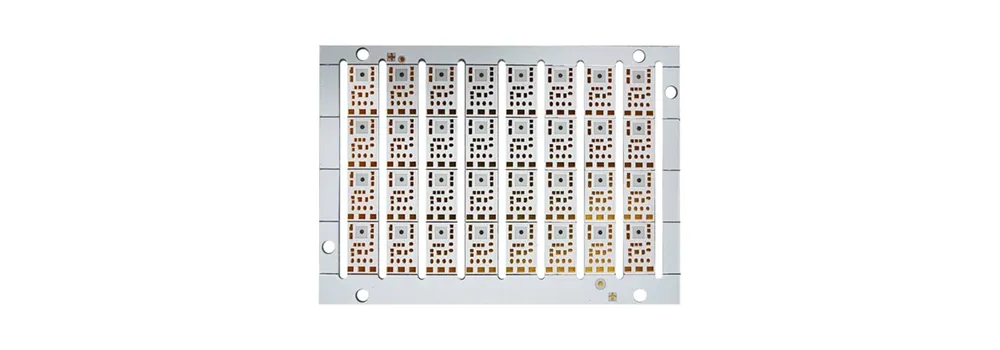
ENIG Aluminum PCB
Surface Finishing Options for Aluminum PCBs
Choosing the right surface finish for Aluminum PCBs is crucial for solderability, corrosion resistance, and long-term reliability. Different finishes suit different components, assembly processes, and application environments.
- ENIG (Electroless Nickel Immersion Gold): Provides excellent solderability and corrosion resistance, ideal for fine-pitch components and multiple reflow cycles, ensuring long-term reliability in high-performance applications.
- HASL (Hot Air Solder Leveling): A cost-effective finish with good solderability. Thermal stress during application requires careful process control when applied to aluminum substrates.
- OSP (Organic Solderability Preservative): A thin, cost-effective finish suitable for single reflow applications. Minimizes thermal stress and ideal for boards with simple assembly requirements.
- Immersion Silver / Immersion Tin: Used for applications requiring flat surfaces or specific soldering characteristics. Selection depends on component types, assembly process, environmental conditions, and cost considerations.
Key Considerations for Aluminum PCB Finishing Selection
When selecting a surface finish for an Aluminum PCB, designers must consider multiple factors, including the thermal expansion properties of the aluminum substrate, potential thermal stress during soldering and assembly, the types, pitch, and density of components, the number of reflow cycles and complexity of the assembly process, environmental conditions and long-term reliability requirements, as well as cost constraints and production volume. Careful evaluation of these factors ensures reliable solder joints and optimal performance in demanding applications.
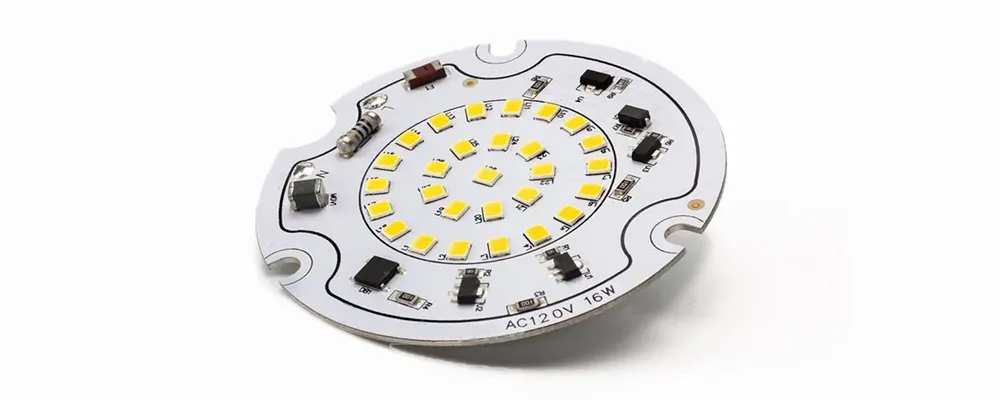
LED Aluminum PCB
Applications of Aluminum PCBs
LED Lighting
Aluminum PCBs dominate the LED lighting market, enabling higher power densities and improved light output. The superior thermal management extends LED lifespan and maintains consistent performance in high-brightness applications.
Automotive Electronics
Automotive systems increasingly use aluminum PCBs for power management modules, LED headlights, and electric vehicle charging systems. The mechanical stability and thermal performance of aluminum substrates make them ideal for temperature extremes and high-vibration environments.
Medical Equipment
Medical devices such as surgical lighting, imaging equipment power supplies, and patient monitoring systems benefit from aluminum PCBs’ reliability and thermal stability. The dimensional stability of the aluminum substrate ensures consistent operation over extended periods.
Industrial Power Electronics
Applications including motor drives, power converters, and solar inverters utilize aluminum PCBs for high power densities in compact form factors. Their thermal performance helps maintain efficiency and prolong device lifespan.
Telecommunications
Base station amplifiers and power management systems in telecom infrastructure employ aluminum PCBs to handle high-power operation with effective heat dissipation, ensuring reliability and long-term performance.
Aluminum PCB vs Other PCB Types
Aluminum PCB vs FR4 PCB
Aluminum PCBs offer thermal conductivity 10–25 times higher than FR4 boards, enabling significant reductions in component operating temperatures. FR4, however, provides greater design flexibility with multilayer capabilities and lower costs for complex circuitry.
Aluminum PCB vs Copper PCB
Copper PCBs deliver superior thermal performance, with thermal conductivity reaching up to 400 W/mK. However, this comes at substantially higher material costs and increased weight compared to aluminum PCBs.
Aluminum PCB vs Ceramic PCB
Ceramic PCBs provide excellent thermal and electrical properties but are challenging to manufacture and carry higher costs. Aluminum PCBs strike a balance by offering good thermal performance at a moderate cost.
Performance Summary
Aluminum PCBs can reduce LED junction temperatures by 10–30°C compared to FR4 under equivalent conditions, while maintaining costs approximately 20–40% above standard FR4 construction. The optimal choice of PCB type depends on application requirements, including thermal management, electrical performance, mechanical constraints, and budget considerations.
Cost Factors of Aluminum PCBs
Material Selection
The choice of aluminum alloys and dielectric materials significantly impacts cost. Premium materials can increase prices by 50–100% compared to standard options but may provide essential performance benefits for high-demand applications.
Manufacturing Complexity
Costs rise with specialized drilling, handling, and quality control procedures. Single-sided aluminum PCBs typically cost 30–60% more than equivalent FR4 boards, while double-sided and multilayer constructions can increase costs by 100–300%.
Volume Considerations
Pricing is highly dependent on production volume. Prototypes may cost 5–10 times more per unit than production volumes exceeding 1,000 pieces.
Surface Finishing
Surface finishes contribute 10–25% to total cost, with premium finishes like ENIG adding more than basic HASL treatments.
Design Optimization
Design strategies such as standardized thicknesses, simplified stackups, and efficient panelization can reduce costs. Long-term benefits include improved reliability, reduced thermal management hardware, and extended component lifecycles.
Advantages and Disadvantages of Aluminum PCBs
| Advantages | Disadvantages |
|---|---|
| Superior thermal conductivity (1.0–8.0 W/mK vs 0.3 W/mK for FR4) | Higher initial costs compared to FR4 boards |
| Lightweight construction compared to copper alternatives | Limited multilayer capabilities due to manufacturing complexity |
| Excellent mechanical durability and dimensional stability | Specialized drilling and processing requirements |
| Environmentally friendly with recyclable aluminum content | Design flexibility constraints with single-sided configurations |
| Enhanced component reliability through better thermal management | Thermal expansion mismatch considerations during assembly |
| Reduced system cooling requirements | Limited availability of specialized materials and processes |
Performance Trade-offs
The advantages typically outweigh disadvantages in applications where thermal management is critical for performance and reliability. Cost premiums are often justified by improved system performance and reduced cooling system complexity.
Application Suitability Considerations
Design engineers must evaluate thermal requirements against design complexity and cost constraints when selecting aluminum PCBs. Applications with high power densities and limited space for cooling systems benefit most from aluminum substrate technology.
Conclusion
Aluminum PCBs represent a critical technology for modern electronics where thermal management, reliability, and performance converge. Their superior thermal conductivity, mechanical stability, and cost-effectiveness make them indispensable for LED lighting, automotive electronics, power management, and industrial applications.
The three-layer construction efficiently combines electrical functionality with thermal management, enabling higher power densities and improved component reliability. While aluminum PCBs require specialized design considerations and manufacturing processes, their benefits in thermal performance and long-term reliability justify their adoption in demanding applications.
As electronic systems continue to increase in power density and performance requirements, aluminum PCBs will remain essential for maintaining optimal operating temperatures and ensuring reliable operation across diverse applications.
Why Choose Haoyue Electronics for Aluminum PCB Projects
- Extensive Manufacturing Experience: Over 15 years of specialized expertise in aluminum PCB production across LED lighting, automotive electronics, and industrial applications with proven track record in high-volume manufacturing.
- Comprehensive PCB Technology Portfolio: Full range of aluminum PCB types including single-sided, double-sided, multilayer, and flexible configurations with capabilities for complex hybrid aluminum-FR4 constructions.
- Advanced Thermal Management Optimization: In-house thermal modeling and design optimization services utilizing advanced simulation software to maximize heat dissipation efficiency while minimizing system costs.
- Precision Manufacturing and Surface Treatment: State-of-the-art equipment for specialized aluminum PCB processing including controlled-impedance drilling, advanced surface finishing options (ENIG, HASL, OSP, Immersion Silver/Tin), and thermal stress management.
- Comprehensive Quality Certifications: ISO9001, ISO13485, ISO14001, and IATF16949 certified facilities ensuring consistent quality standards for automotive, medical, and industrial applications with full traceability documentation.
- Complete One-Stop Solution: Integrated services spanning PCB manufacturing, component procurement, PCBA assembly, and final product assembly under one roof, reducing supply chain complexity and lead times.
- Global Logistics and Support: Worldwide delivery capabilities with comprehensive technical documentation, multilingual customer support, and ongoing engineering consultation throughout project lifecycle.