
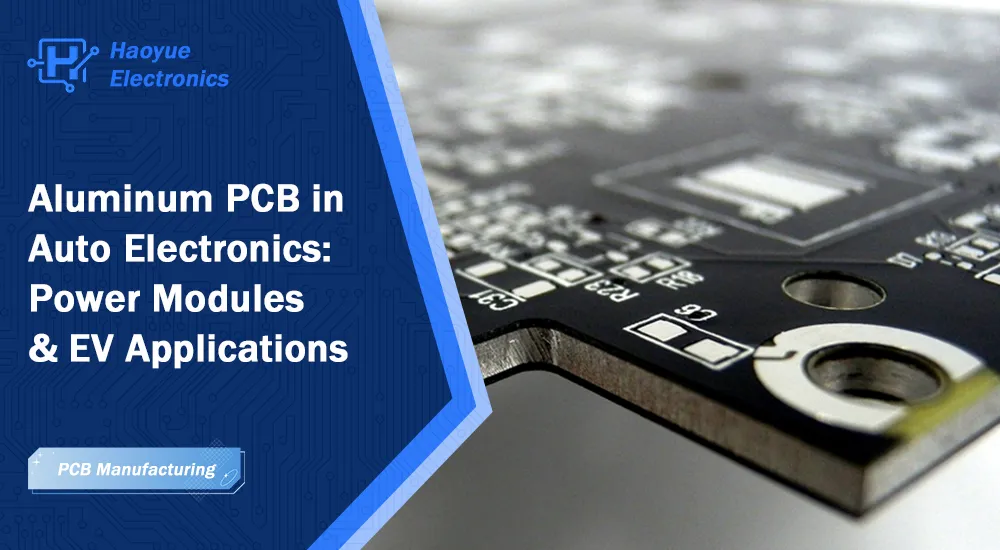
The automotive industry’s transition toward electrification and autonomous driving technologies has intensified the thermal challenges faced by electronic systems. Power modules, battery management systems, and motor controllers generate substantial heat that requires efficient dissipation to ensure reliability and longevity. Aluminum PCBs address these challenges through their exceptional thermal conductivity properties and robust construction.
Thermal Challenges in Modern Automotive Power Systems
High-Power Density Requirements
Contemporary automotive electronics operate at significantly higher power densities compared to previous generations. Electric vehicle power inverters, for instance, must handle currents exceeding 400 amperes while maintaining compact form factors. This combination creates thermal hotspots that traditional FR4 PCBs cannot adequately manage.
The thermal environment within electric vehicles presents unique challenges. Battery pack temperatures can fluctuate between -40°C and 85°C, while power electronics generate additional heat during high-performance driving scenarios. Without proper thermal management, component degradation accelerates, leading to reduced efficiency and potential system failures.
Reliability Implications
Thermal cycling represents one of the primary failure mechanisms in automotive electronics. Each heating and cooling cycle creates mechanical stress within PCB materials, potentially causing delamination, via barrel cracking, and solder joint fatigue. Aluminum PCBs mitigate these risks through their superior thermal stability and reduced coefficient of thermal expansion mismatch.
Aluminum PCB Technology: Engineering Excellence for Automotive Applications
Advanced Material Composition and Structure
Aluminum PCBs employ a sophisticated three-layer architecture optimized for thermal performance. The base aluminum layer, typically 1.0-3.0mm thick, serves as the primary thermal pathway. High-thermal-conductivity aluminum alloys, such as 5052 or 6061, provide thermal conductivity values ranging from 1.5 to 8.0 W/m·K, substantially exceeding FR4’s 0.3 W/m·K rating.
The dielectric layer represents the most critical design element, requiring precise engineering to balance thermal conductivity with electrical isolation. Advanced thermally conductive dielectrics achieve thermal conductivity values between 1.0-3.0 W/m·K while maintaining breakdown voltages exceeding 3000V. This performance enables safe operation in high-voltage automotive applications, including 800V electric vehicle architectures.
Thermal Interface Optimization
The copper circuit layer thickness typically ranges from 35μm to 105μm, selected based on current-carrying requirements and thermal considerations. Heavier copper weights enhance both electrical conductivity and thermal spreading, particularly beneficial for power module applications where localized heat generation occurs.
Surface treatments play a crucial role in thermal performance optimization. Immersion silver or ENIG (Electroless Nickel Immersion Gold) finishes provide excellent thermal interfaces while ensuring long-term reliability in harsh automotive environments. These finishes maintain low thermal resistance contacts between components and the PCB surface.
Manufacturing Process Considerations
The manufacturing process for automotive aluminum PCBs requires stringent quality controls to ensure consistent thermal performance. The dielectric adhesion process utilizes controlled temperature and pressure profiles to eliminate voids that could compromise thermal conductivity. Advanced vacuum lamination techniques ensure uniform dielectric thickness, critical for maintaining consistent thermal resistance across the board.
Quality validation includes thermal impedance testing using JEDEC JESD51-14 standards, ensuring aluminum PCBs meet automotive thermal performance specifications. Thermal cycling tests according to AEC-Q100 standards verify long-term reliability under automotive operating conditions.
Power Module Applications in Electric Vehicle Systems
Motor Drive Systems
Electric vehicle motor controllers represent one of the most demanding applications for aluminum PCBs. These systems must manage three-phase AC power with switching frequencies up to 20 kHz while maintaining efficiency levels exceeding 95%. The power semiconductors, typically SiC MOSFETs or IGBT modules, generate significant heat during switching operations.
Aluminum PCBs enable compact motor controller designs by efficiently spreading heat from power devices to the housing. This thermal management capability allows engineers to increase power density while maintaining safe junction temperatures. The result is reduced system weight and improved vehicle efficiency.
Battery Management Systems
Battery management systems require precise temperature monitoring and control to ensure safe lithium-ion battery operation. Aluminum PCBs support high-current battery contactor circuits while maintaining thermal stability during fault conditions. The enhanced thermal conductivity helps dissipate heat from current sensing resistors and protection circuits.
DC-DC Converters
High-power DC-DC converters in electric vehicles operate at power levels exceeding 20kW, converting high-voltage battery power to 12V for auxiliary systems. These converters employ synchronous rectification techniques that generate substantial heat in the switching devices. Aluminum PCBs provide the thermal management necessary for reliable high-efficiency operation.
Auotmotive
Advanced Thermal Management in High-Power Automotive Electronics
Thermal Modeling and Simulation
Effective aluminum PCB design requires comprehensive thermal modeling using finite element analysis. Engineers utilize software tools to predict temperature distributions and identify thermal bottlenecks before prototype fabrication. These simulations account for component placement, trace routing, and thermal via placement to optimize heat flow.
Thermal vias play a critical role in connecting the circuit layer to the aluminum base, creating efficient thermal pathways. Via design parameters, including diameter, depth, and fill material, significantly impact thermal performance. Optimized via patterns can reduce thermal resistance by 20-30% compared to standard configurations.
Component Integration Strategies
Strategic component placement maximizes aluminum PCB thermal benefits. High-power components should be positioned to take advantage of direct thermal paths to the aluminum base. Thermal pads beneath components enhance heat transfer, while keepout areas prevent thermal interference between adjacent heat sources.
Design Considerations for Automotive Aluminum PCB Implementation
Electrical Design Constraints
Aluminum PCBs impose specific electrical design considerations due to their single-layer copper configuration. Signal routing requires careful planning to avoid conflicts with power traces and thermal management features. High-speed signals may require impedance control techniques adapted for aluminum substrate characteristics.
Mechanical Integration
The mechanical properties of aluminum PCBs differ significantly from traditional FR4 boards. The increased stiffness and thermal expansion characteristics must be considered during mechanical design. Mounting strategies should accommodate thermal expansion while maintaining electrical connections.
Environmental Compliance
Automotive aluminum PCBs must comply with industry standards including AEC-Q100 for integrated circuits and ISO 16750 for electrical and electronic equipment. These standards specify temperature cycling, vibration, and humidity requirements that aluminum PCBs must withstand throughout the vehicle’s operational life.
Why Choose Haoyue Electronics for Your Automotive PCB Projects
Haoyue Electronics delivers comprehensive aluminum PCB manufacturing and assembly solutions specifically designed for demanding automotive applications. Our expertise in thermal management and automotive-grade quality standards ensures your power module and EV projects achieve optimal performance and reliability.
Our Automotive PCB Capabilities
- Advanced Aluminum PCB Manufacturing: Complete in-house production capabilities for automotive-grade aluminum PCBs with thermal conductivity up to 3.0 W/m·K
- High-Power Application Expertise: Specialized experience in power module PCBs supporting currents up to 500A and voltages up to 1000V
- Automotive Quality Standards: Full compliance with AEC-Q100, ISO 16750, and IATF 16949 quality management systems
- Thermal Design Optimization: Advanced thermal modeling and simulation services to maximize heat dissipation performance
- Complete Assembly Services: Full PCB assembly capabilities including automotive-grade component sourcing and testing
- EV-Specific Solutions: Tailored aluminum PCB designs for battery management systems, motor controllers, and charging infrastructure
- Rapid Prototyping: Fast-turn prototyping services to accelerate your automotive development timeline
- Long-Term Partnership: Comprehensive support from design consultation through volume production and ongoing quality assurance
Contact Haoyue Electronics today to discuss how our aluminum PCB expertise can enhance your automotive electronics projects. Our engineering team is ready to collaborate on your next-generation power module and EV applications, delivering the thermal management solutions your designs require for automotive excellence.